The first order of business? Deciding when and how to travel. The train was a no-brainer. Not only is it the cheaper option compared to the luxury buses that depart from Wellawatta, it's also easier than driving for over 10 hours and more spacious than the bus!

The Heart of Sri Lanka’s North
Wander through centuries of culture, taste, and northern beauty


The plan was to leave on a Friday night and return late on Sunday or early Monday. The earlier, the better.
(Hey, I have an indoor cat I would be leaving alone! As much as I love travelling, Pippin being alone is too much for me.) So, with the hows and the whens settled, it was time to pack for Jaffna. And that meant ditching the hoodies and sweats that kept me warm from the relentless rain (I get cold when the temperature goes below 26°C). Jaffna’s weather demands light, breathable fabric, although modesty also has to be a factor.
The journey
For those unaware of it, the train ride to Jaffna is one of the best in Sri Lanka. However, if you want to enjoy the scenery, the train departing at 10 p.m. from Mount Lavinia differs from the ride you want. I suggest taking an earlier train. That said, having reserved seats at the last minute and dedicating the daylight hours to packing and cleaning (whoever enjoys coming home to a mess after a trip is not someone I want to be friends with), the night train was my only option.

The station is eerie at night, but it just adds to the experience
An unseen side of Jaffna
After an uncomfortable train ride trying to contort myself to find the most comfortable way to nap on a non-reclining coach seat (look, I love travelling, but I wasn’t going to see much of anything at night, I might as well try to sleep), I woke up to just-past-dawn sunlight filtering through the clouds. After a lifetime of living in cities and travelling to mountainous areas and /or beaches, vast, flat lands always take me by surprise. Seeing for miles without buildings, trees, hills, mountains or so blocking the view is refreshing. But also somewhat eerie.

Be sure to grab a window seat to enjoy the sunset
After dumping our stuff in the hotel (and catching up on some _much-_needed sleep on a comfortable bed), it was time to head out and meet the rest of the group. It was only around 8 a.m., and I could tell that the day would be much warmer than it would be back in rain-soaked Colombo. That is one of the most significant advantages of travelling to Jaffna during this trip!
On the way to Puttur...
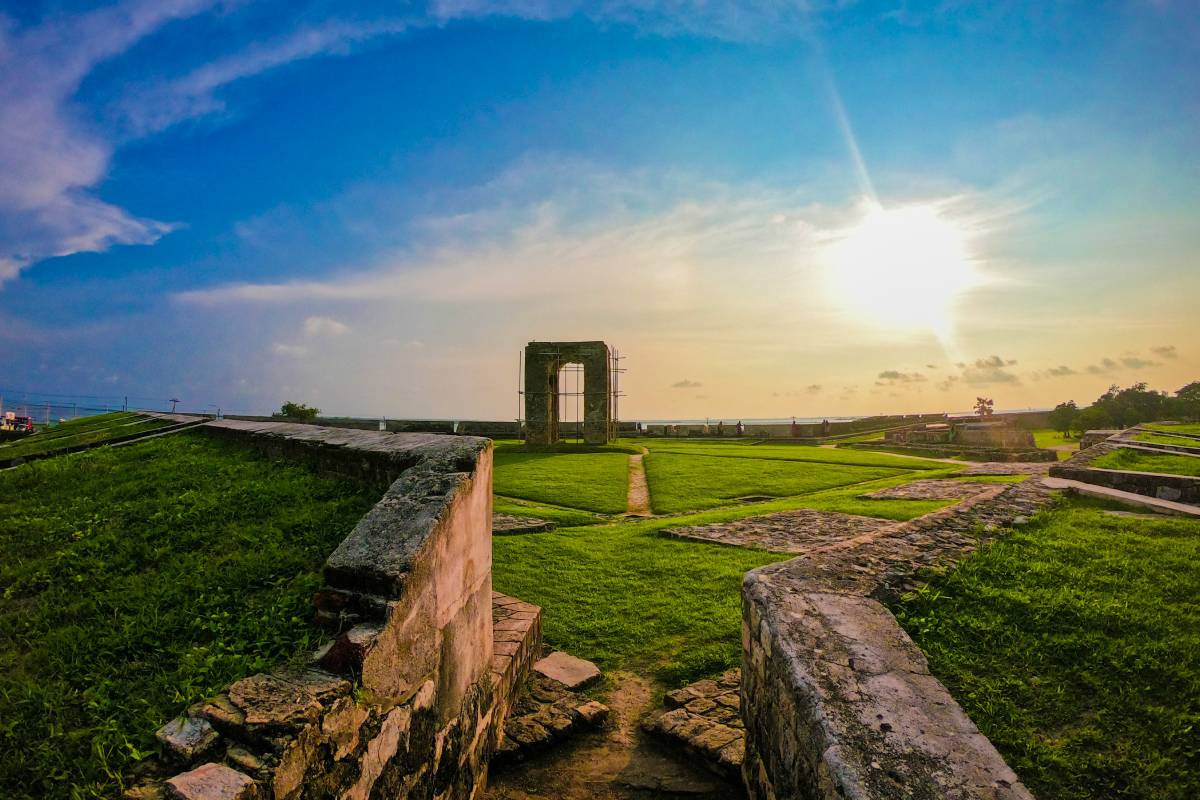
No, I didn’t suddenly materialise in Puttur, India, while travelling to Jaffna. Puttur is, coincidently, a small town about 12km away from Jaffna that shares a name with an Indian city. It is also the hometown of the family friend who invited us to visit. So rather than hitting up the famous tourist destinations in Jaffna, we were about to get a more intimate look at the daily lives of the locals. On the way from Jaffna to Puttur, we, of course, passed by the Jaffna Fort. The sprawling star-shaped fort is the second-largest Dutch Fort in Sri Lanka. During the Sri Lankan Civil War, the landmark received some damages, which have since been renovated. So it does look better-maintained and relatively new, despite how old it is.

The fort spreads out and is unmistakable
However, that is your impression as you pass it on the road. Once you visit the fortification, you see signs of how old it is and what the years have done to it. But that’s a story for another day! Jaffna is like many medium to large towns in Sri Lanka, with several significant differences. One of these differences lies in the population; with most locals being Hindu, you hear a lot of Tamil. Many storefronts also bear Tamil names, although road signs are also offered in Sinhala and English. So navigation is easy. And while the people are warm and welcoming, it isn’t easy to truly interact unless a) you are fluent in Tamil or b) they are fluent in Sinhala or English. (I did not expect to feel so alienated in my own country. Maybe Mom had a point when she lectured me about reading novels instead of paying attention during my seventh-grade Tamil period at school…) The sheer number of Kovils is another thing that sets the town apart. Where towns in the more Buddhist areas tend to have several temples, Jaffna offers beautiful kovils.
The windiest area in Sri Lanka?
Like most of the peninsula, Puttur, too, is relatively flat. However, the area has enough palm trees, residential buildings, banana estates, shops and so on that you don’t get uninterrupted views.

The roads are surprisingly empty, even at noon
It is also extremely windy. The wind isn’t too strong, so it’s not a problem; you aren’t in danger of having your belongings blown away due to strong gusts. It’s just constant enough that you don’t feel the sun’s relentless heat. Arriving at the brightly painted house, we were greeted warmly with shy smiles and refreshments. Sure, the language barrier gets in the way of natural interactions. But a combination of common words, phrases, gestures and timely interpretations served us well enough.
A rare glimpse into an unseen side of a kovil
After introductions were out of the way, we were again on the road. Since Puttur was conveniently sitting less than 10 minutes away from a mysterious (not-so) bottomless well, it was the perfect time to explore. On the way, we made a brief visit to Puttur Kovil. Although the kovil survived the Civil War intact, old age was something it could overcome with renovations. So it was a once-in-a-lifetime opportunity to see behind the curtains. Colourful kovils with their proud gopurams featuring idols of Hindu deities can fill you with awe. And while this under-construction kovil also filled me with awe, it was for a completely different reason. A local artist was making the idols that usually adorn the gopurams by hand, using bricks and cement. While they were yet to be painted, I could easily see all the intricate details. The inner sanctum was in complete disarray while the construction was going on. And it was easy to see the difference the renovation was bringing on. Where the existing designs, paintings and statues had a simple charm, the newer structures were more elaborate. It was already apparent that once the constructions were finished (which would take upwards to seven years, apparently!), the kovil would look grander.
Nilavarai Well
Nilavarai Well is a well-known destination in Jaffna, attracting visitors due to one big mystery: no one knew how deep it was. People referred to it as the ‘bottomless well’. At one point, there were even theories that it connects to the sea, somehow. Well, the mystery is now gone. The Sri Lankan Navy sent a team of divers to discover how deep the well goes. Using an automated robot, they found that the well has a depth of 52.5 metres. According to the findings, the first 13.8 metres contained fresh water. While beyond that depth, the water began to turn salty.

The silence at the well simply enhance its mysterious vibes
The well is not accessible – a guard rail encircles the well, and I assume you need permission to climb down the flight of stairs that lead to the water. However, you can approach the rail and gaze at the dark water. The darkness comes because of the depth, not the level of pollution. In fact, the water is clear enough to see fish swimming closer to the surface!
Night falls in Jaffna
After visiting Naga Vihara International Buddhist Centre, we returned to Puttur for a late lunch and a birthday celebration. While the spices may have been similar to the ones I used while cooking, the flavours were entirely new. The food was not as spicy as I preferred, but the aroma and the taste more than made up for it. I also got to try an entirely new dish: mutton blood fry. If you don’t know that the main ingredient is mutton blood (as I didn’t), it looks like any other meat-based dish. As the blood cooks, it turns a dark brown, and with the addition of the spices, the fry looks closer to black. However, it had a great texture – not too tough or soft – and the taste was out of this world! The sun was setting as the birthday party wound down, and it was time to make the 12-kilometre journey back to the hotel. I was caught off guard by just how dark the night is, as light pollution is minimal. After making plans for the next day and our return to Colombo, it was time to close the first day of travelling to Jaffna.
Ready to Discover Jaffna?
Join our Scenic Wonders of Sri Lanka journey With BSL Tours, you’ll find the rhythm of surf, sand, and serenity.
About Gayathri Kothalawala
A senior travel writer at BSL Tours, with an eye for Sri Lanka’s romantic landscapes and timeless charm. Through her words, she brings to life the island’s serene beaches, misty hills, and soulful traditions, inspiring travellers to uncover the most intimate side of Sri Lanka.